Understand the basics of the Small Business Programs, including:
- Comparing SBIR and STTR
- Different funding paths and phases of the program
- Budget and timelines for funding
- Eligibility criteria
- Foreign disclosure and risk management
NIH recognizes that some biomedical innovations require additional funding to reach the marketplace. For those topics, the NIH has a waiver from the Small Business Administration to allow larger awards (Phase I and Phase II only). Please refer to NIH Institute, Center, and Office (ICO) Funding Considerations for Small Business to review approved waiver topics.
Our ULTIMATE goal is to help you successfully apply for funding AND teach you how to navigate the process so you can confidently apply again in the future. We know firsthand how demanding it is to apply for NIH funding, which is why we offer the Cohorts. Starting early is paramount!
Two Stages of Support – Stage 1: Formal Education and Stage 2: Individualized Coaching
Stage 1: Formal Education. This stage is focused on learning the NIH SBIR/STTR requirements to build the knowledge needed to prepare a competitive application, including application components, review criteria, the submission process, budgeting and cost-accounting requirements, developing an indirect cost rate, and much more. Stage 2 requires participation in all educational sessions.
Ready to Continue?
This is an important decision point. We understand that you have many competing demands on your time, so we want you to carefully consider whether now is the right time to apply. Moving forward means being prepared to dedicate the time, energy, and attention needed to develop a high-quality, competitive NIH application.
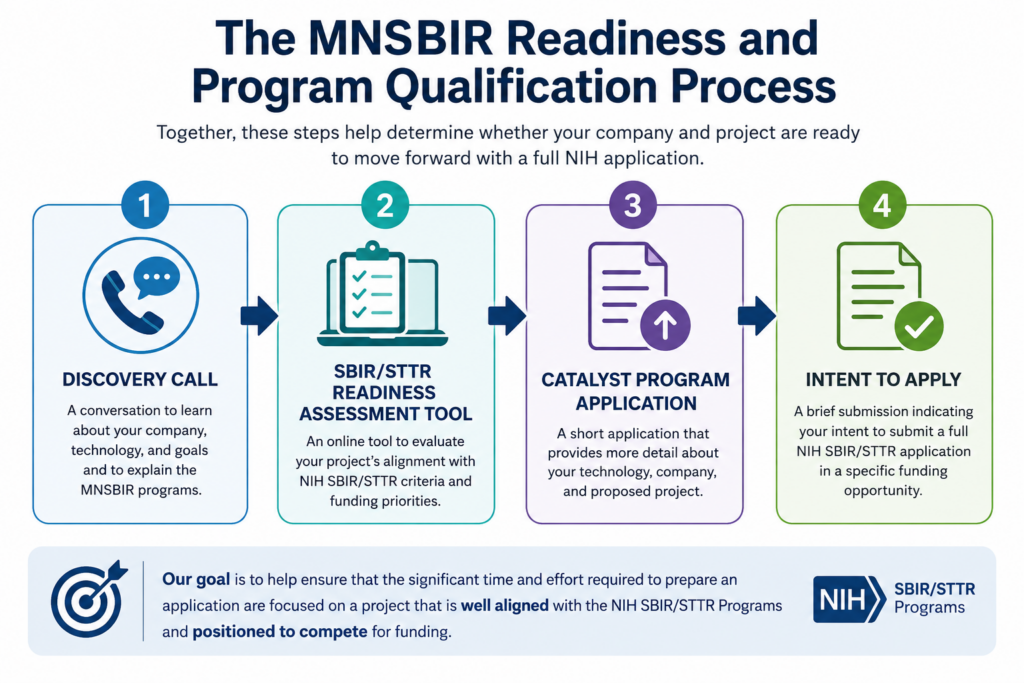
Next step: If you are new to MNSBIR and have not yet been accepted into our Catalyst Program, we will guide you through the next steps as shown below in the graphic. If your firm is already approved for the Catalyst Program, you can simply complete the Intent to Apply.
 Stage 2: Individualized Coaching and Support. This is where the real work begins. We work alongside you throughout the application process, helping you stay on track, answer questions, and navigate challenges as they arise. At this stage, you receive one-on-one coaching and individualized support tailored to your company, research project, and NIH application. Depending on the scope of the project, our support may range up to 20 hours per project, delivered by our team including independent contractors paid by MNSBIR, Inc.